
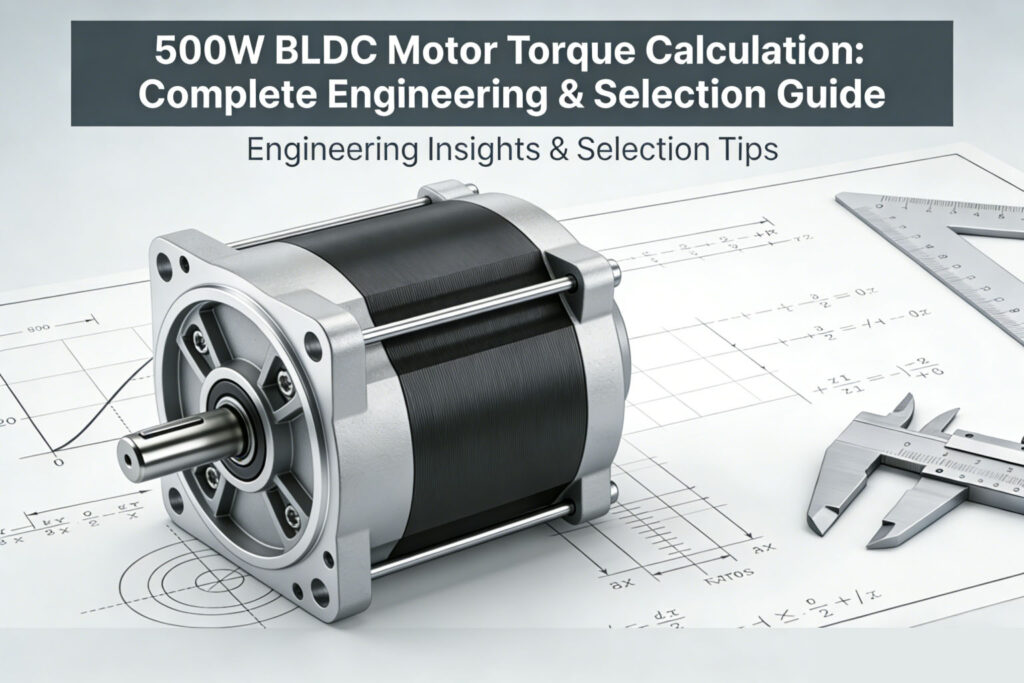
500W BLDC motormomentberegning: Komplet Engineering & Valgvejledning
Udvalgt uddrag:
Torque calculation for a 500W BLDC motor is based on the relationship between power, hastighed, og drejningsmoment. The fundamental equation is: Moment (Nm) = Magt (W) ÷ Angular Speed (rad/s). I praktiske applikationer, engineers must also consider efficiency, load conditions, duty cycle, and control methods. A 500W BLDC motor typically produces between 1.5–3 Nm depending on RPM and design. Accurate torque calculation ensures proper motor sizing, prevents overheating, and improves system reliability in industrial, EV, and automation applications.
What is a 500W BLDC Motor and Why Torque Calculation Matters
EN 500W BLDC motor is a brushless DC motor designed to deliver approximately 500 watts of mechanical output power. These motors are widely used in electric bikes, pumper, AGV robotter, and industrial automation systems due to their high efficiency, kompakt størrelse, and long lifespan.
Torque calculation is critical because power alone does not define performance. In real industrial applications, torque determines whether the motor can start, fremskynde, and sustain load conditions. Engineers often face challenges such as undersized motors leading to overheating or oversized motors increasing system cost unnecessarily.
For OEM buyers and procurement managers, understanding torque calculation helps avoid common issues such as insufficient starting torque, poor speed regulation, and premature motor failure. This is especially important when integrating motors into customized systems like conveyors or electric mobility solutions.
Basic Formula for 500W BLDC Motor Torque Calculation
Core Equation
The fundamental formula used in torque calculation is:
Moment (T) = Magt (P) ÷ Angular Speed (åh)
Hvor:
- P = Power in watts (W)
- ω = Angular speed in radians per second (rad/s)
Converted Engineering Formula
In practical engineering applications, the formula is often expressed as:
T (Nm) = 9550 × P (kW) ÷ RPM
For a 500W motor (0.5 kW):
T = 9550 × 0.5 ÷ RPM
Eksempel på beregning
- At 3000 RPM → Torque ≈ 1.59 Nm
- At 1500 RPM → Torque ≈ 3.18 Nm
This demonstrates a key engineering principle: lower speed results in higher torque for the same power rating.
Why Torque Calculation is Critical in Industrial Applications
In industrial environments, torque directly affects system performance, especially in applications such as pumps, transportører, and robotic actuators. Incorrect torque estimation leads to operational inefficiencies and increased maintenance costs.
For eksempel, in pump systems, insufficient torque can prevent startup under load due to fluid resistance. In conveyor systems, torque must overcome both static friction and dynamic load variations. Engineers must also consider peak torque requirements during acceleration phases.
From a procurement perspective, selecting a motor based solely on power rating without torque analysis often results in system redesign or failure during commissioning. Derfor, torque calculation is not just a theoretical exercise but a practical necessity in B2B motor sourcing.
Technical Factors Affecting BLDC Motor Torque
Efficiency Impact
BLDC motors typically operate at 85–92% efficiency. Actual torque output is reduced by losses in windings, controller, and mechanical components. Engineers must adjust calculations accordingly.
Momenttæthed
BLDC motors offer higher torque density compared to traditional AC motors due to permanent magnet design. This allows compact systems with high output capability, particularly important in EV and robotics applications.
Termisk ydeevne
Heat generation affects torque stability. Overheating reduces magnetic strength and winding efficiency, leading to torque drop. Proper cooling methods such as forced air or liquid cooling are essential.
Control System Influence
Torque in BLDC motors is controlled via current. Advanced controllers enable precise torque control, especially in field-oriented control (FOC) systemer. Poor controller matching can result in unstable torque output.
Pålidelighed & Lifespan
Operating a motor continuously near maximum torque reduces lifespan. Engineers typically design systems to operate at 70–80% of rated torque for long-term reliability.
500W BLDC Motor vs AC Motor: Torque Performance Comparison
| Parameter | 500W BLDC Motor | AC Induction Motor |
|---|---|---|
| Effektivitet | 85–92 % | 70–85 % |
| Drejningsmomentkontrol | Præcis (elektronisk) | Limited without VFD |
| Starting Torque | Høj | Moderat |
| Opretholdelse | Lav | Moderat |
| Koste | Higher initial | Lower upfront |
From an engineering perspective, BLDC motors provide superior torque control and efficiency, making them ideal for applications requiring precision and dynamic performance.
BLDC Motor vs Brushed DC Motor: Torque and Efficiency Comparison
| Parameter | BLDC motor | Børstet jævnstrømsmotor |
|---|---|---|
| Effektivitet | Høj | Moderat |
| Torque Stability | Fremragende | Variable |
| Opretholdelse | Minimal | Frequent |
| Lifespan | Long | Shorter |
| Control Complexity | Høj | Lav |
While brushed motors may offer lower initial cost, BLDC motors provide better long-term torque stability and reliability, which is critical for OEM systems.
How to Choose a 500W BLDC Motor for Your Application
Spændingsområde
Common options include 24V, 48V, and 72V. Higher voltage systems improve efficiency and reduce current losses.
Power Range
Ensure the motor can handle peak loads beyond 500W, especially for startup torque requirements.
Speed and Torque Requirements
Define operating RPM and required torque. Use torque calculation formulas to validate selection.
Afkølingsmetode
Options include natural cooling, forced air, and liquid cooling. Industrial environments often require enhanced cooling.
Controller kompatibilitet
Ensure compatibility with BLDC controllers, especially for applications requiring precise torque control.
Anvendelsesspecifikke overvejelser
For eksempel, in e-bike systems, torque determines climbing ability, while in pumps, it affects fluid movement efficiency.
For customized solutions, explore:
BLDC Motor Solutions |
EV Motor Systems |
Spærreporte |
CTA: Request datasheet or contact our engineers for OEM motor selection support.
Anvendelser af 500W BLDC-motorer
Industrielle applikationer
Used in conveyors, automationssystemer, and packaging machinery where consistent torque is required.
Elektriske køretøjer
Common in e-bikes and scooters, where torque directly impacts acceleration and hill climbing performance.
Pump Systems
BLDC motors improve energy efficiency and provide stable torque for fluid handling applications.
Robotik
Precise torque control enables accurate motion control in robotic arms and AGV systems.
Common Mistakes in Torque Calculation
One of the most common mistakes is ignoring efficiency losses. Engineers often calculate theoretical torque without considering real-world conditions such as friction and heat.
Another issue is underestimating peak torque requirements during startup. Many applications require significantly higher torque at startup than during steady operation.
Derudover, improper controller selection can limit torque output even if the motor is correctly sized. This highlights the importance of system-level design rather than component-level selection.
Future Trends in BLDC Motor Torque Optimization
The future of BLDC motor technology is focused on improving torque density and efficiency. Advanced materials such as high-performance magnets and improved winding techniques are increasing torque output without increasing size.
Integration with smart controllers and IoT systems allows real-time torque monitoring and predictive maintenance. This is particularly valuable in industrial environments where downtime is costly.
For OEM manufacturers, these trends mean more compact designs, lower energy consumption, and improved system reliability.
FAQ: 500W BLDC motormomentberegning
1. How much torque does a 500W BLDC motor produce?
Typisk mellem 1.5 Nm og 3 Nm depending on RPM. Lower speeds result in higher torque output.
2. Why is torque more important than power?
Torque determines the motor’s ability to move loads, especially during startup and acceleration.
3. Can a 500W motor handle heavy loads?
Ja, if properly geared and matched with the correct speed and torque requirements.
4. How does RPM affect torque?
Torque decreases as RPM increases for a fixed power rating.
5. What is the best 500W BLDC motor for industrial use?
The best option depends on application requirements, inklusive drejningsmoment, hastighed, og miljøforhold.
Konklusion: Engineering Approach to 500W BLDC Motor Torque Selection
Accurate torque calculation is essential for selecting the right 500W BLDC motor. Engineers must consider not only theoretical formulas but also real-world factors such as efficiency, termisk ydeevne, og kontrolsystemer.
For OEM buyers, the goal is to balance cost, præstation, og pålidelighed. A well-selected motor improves system efficiency, reduces maintenance, and enhances product competitiveness.
CTA: Contact our engineers to get a customized motor solution or request a detailed datasheet tailored to your application.
Referencer
- IEC 60034 Rotating Electrical Machines Standards
- IEEE Transactions on Industrial Electronics
- Motor Control Theory – Field Oriented Control (FOC)
- Electric Motor Handbook – Engineering Applications