
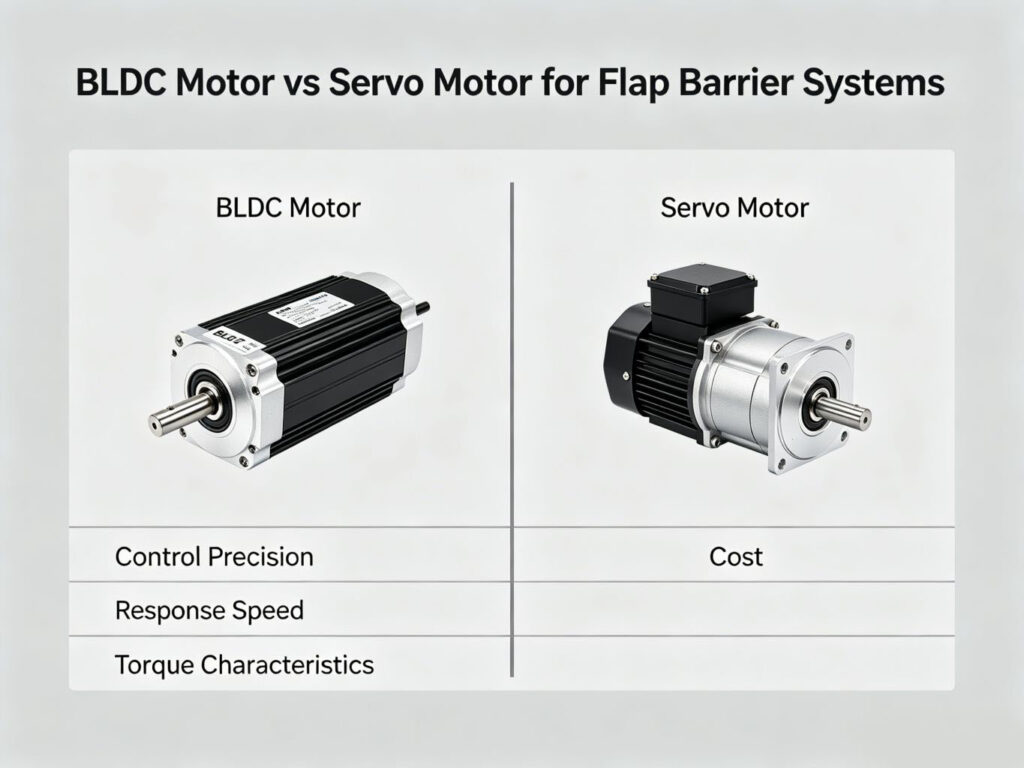
محرك BLDC مقابل محرك سيرفو لأنظمة حاجز الرفرف
BLDC motors and servo motors are the two most common motion control technologies used in modern flap barrier systems. Both provide precise control, rapid response, وعملية موثوقة, but they differ significantly in cost structure, control complexity, thermal performance, torque characteristics, and long-term maintenance requirements.
For most industrial flap barrier systems, high-performance BLDC motors provide the best balance between speed, كثافة عزم الدوران, كفاءة, مصداقية, and OEM cost optimization. Servo motors offer extremely high positioning accuracy and dynamic control performance, but their higher system cost and control complexity are often unnecessary for standard access control applications.
Understanding the engineering differences between BLDC motors and servo motors is essential for OEM manufacturers, procurement engineers, and system integrators selecting motors for flap barriers, swing gates, intelligent access systems, and high-cycle pedestrian control equipment. This guide explains the complete technical comparison while helping buyers make better long-term procurement decisions.
What Is a BLDC Motor for Flap Barrier Systems?
محرك بي إل دي سي (محرك DC بدون فرشات) is an electronically commutated motor widely used in modern flap barrier systems because of its high efficiency, هيكل مدمج, fast dynamic response, and low maintenance requirements.
How BLDC Motors Work
على عكس المحركات المصقولة, تستخدم محركات BLDC التخفيف الإلكتروني بدلاً من الفرش الميكانيكية. The controller continuously switches current through the stator windings according to rotor position feedback.
This creates:
- Smooth rotational motion
- Rapid acceleration
- Precise speed control
- Lower mechanical wear
- Higher operating efficiency
Why BLDC Motors Are Popular in Flap Barriers
Modern flap barriers require:
- Fast opening and closing
- Low noise operation
- Compact installation size
- Continuous-duty capability
- Minimal maintenance
BLDC motors satisfy these requirements efficiently while maintaining lower overall system cost compared with servo systems.
Related industrial motor solutions:
BLDC motor for flap barrier
What Is a Servo Motor in Flap Barrier Applications?
Servo motors are closed-loop motion systems designed for highly precise position, سرعة, والتحكم في عزم الدوران. Servo systems commonly include:
- محرك
- Encoder
- Servo drive
- Advanced control algorithms
How Servo Motors Operate
Servo motors continuously monitor position and speed using encoder feedback. The servo drive dynamically adjusts current output to maintain precise motion profiles.
Advantages of Servo Systems
Servo systems offer:
- Extremely accurate positioning
- High dynamic response
- التحكم الدقيق في عزم الدوران
- Advanced synchronization capability
- Excellent low-speed stability
Why Servo Motors Are Less Common in Standard Flap Barriers
Although servo motors provide excellent precision, many flap barrier applications do not require ultra-high positioning accuracy. In these cases, servo systems may increase:
- System cost
- تعقيد وحدة التحكم
- Integration difficulty
- Maintenance requirements
For many OEM manufacturers, BLDC motors provide a more commercially balanced solution.
محرك BLDC مقابل محرك سيرفو: Core Engineering Differences
| المعلمة | محرك BLDC | محرك سيرفو |
|---|---|---|
| طريقة التحكم | التبديل الإلكتروني | Closed-Loop Servo Control |
| Position Accuracy | عالي | عالية جدًا |
| تكلفة النظام | معتدل | أعلى |
| كثافة عزم الدوران | عالي | عالي |
| كفاءة | 85-92% | 88-94 ٪ |
| تعقيد وحدة التحكم | معتدل | عالي |
| صيانة | قليل | قليل |
| الأداء الحراري | ممتاز | ممتاز |
| OEM Integration | Easier | More Complex |
| Industrial Flap Barrier Suitability | ممتاز | التطبيقات المتخصصة |
من وجهة نظر هندسية, both technologies perform well, but BLDC motors usually provide the best balance between performance and procurement efficiency for access control systems.
مقارنة الكفاءة: محرك BLDC مقابل محرك سيرفو
Motor efficiency directly affects energy consumption, توليد الحرارة, operating stability, and long-term lifecycle cost.
BLDC Motor Efficiency
Modern BLDC motors typically achieve:
- 85–92% operating efficiency
- Low copper loss
- Reduced friction loss
- Excellent partial-load performance
In flap barriers operating continuously throughout the day, high efficiency significantly reduces thermal stress and electricity consumption.
Servo Motor Efficiency
Servo motors may achieve slightly higher peak efficiency under dynamic load conditions, especially in highly precise motion systems.
لكن, flap barriers rarely require the extreme positioning precision that justifies servo system cost premiums.
Why Efficiency Matters for OEM Buyers
Efficiency affects:
- Operating cost
- Power supply sizing
- الإدارة الحرارية
- Cabinet ventilation design
- Long-term reliability
In high-cycle transportation or commercial installations, improved efficiency can significantly reduce maintenance and operational expenses.
Torque Density and Dynamic Performance Comparison
Torque density is one of the most important factors in compact flap barrier system design.
BLDC Motor Torque Characteristics
BLDC motors offer:
- عزم دوران عالي عند الانطلاق
- Rapid acceleration
- Compact dimensions
- Smooth continuous rotation
This enables slim flap barrier cabinet structures without sacrificing performance.
Servo Motor Torque Characteristics
Servo motors provide:
- التحكم الدقيق في عزم الدوران
- Exceptional low-speed stability
- Dynamic load compensation
- Accurate position holding
These advantages are critical in robotics and precision automation but may exceed the practical needs of most flap barrier systems.
Dynamic Response in Access Control Systems
Modern flap barriers require rapid opening cycles combined with smooth deceleration to prevent:
- Mechanical shock
- ضوضاء
- Panel vibration
- Premature wear
Both motor technologies can achieve this, but BLDC systems typically provide simpler implementation and lower total system cost.
Thermal Performance and Reliability Comparison
Thermal behavior directly influences motor lifespan, system stability, and maintenance frequency.
BLDC Motor Thermal Advantages
BLDC motors eliminate mechanical brushes, تقليل:
- Friction heat
- Electrical arcing
- Brush wear
- Maintenance intervals
Their efficient structure supports long continuous-duty operation inside compact barrier cabinets.
Servo Motor Thermal Characteristics
Servo motors also provide strong thermal performance, especially under variable load conditions. لكن, servo drives may generate additional heat due to advanced signal processing and higher switching frequencies.
Reliability Under High Duty Cycles
Transportation hubs and industrial facilities often require millions of operating cycles annually.
Reliability depends on:
- Motor bearing quality
- Cooling design
- Controller tuning
- Current stability
- Mechanical alignment
Well-designed BLDC systems commonly provide operational lifespans exceeding 5–10 years with minimal maintenance.
Control Systems: BLDC vs Servo Motion Control
The control architecture significantly affects system integration complexity and total OEM development cost.
BLDC Motor Control Systems
Modern BLDC motors commonly use:
- FOC (التحكم الميداني)
- Hall sensor feedback
- Encoder systems
- Current monitoring algorithms
FOC control enables smooth torque output and highly stable motion performance.
Servo Motor Control Systems
Servo systems require:
- High-resolution encoders
- Advanced servo drives
- Closed-loop PID tuning
- High-speed communication systems
These systems provide superior precision but increase commissioning complexity.
Which Control System Is Better for Flap Barriers?
For standard pedestrian access systems, modern BLDC controllers provide sufficient precision while simplifying:
- OEM integration
- Software development
- Maintenance procedures
- Production scalability
BLDC Motor vs Servo Motor Cost Comparison
Cost is a major decision factor for OEM buyers and procurement managers.
| عامل التكلفة | محرك BLDC | محرك سيرفو |
|---|---|---|
| تكلفة المحرك | معتدل | أعلى |
| تكلفة وحدة التحكم | أدنى | أعلى |
| Integration Cost | أدنى | أعلى |
| تكلفة الصيانة | قليل | معتدل |
| تكلفة دورة الحياة | ممتاز | أعلى |
| OEM Scalability | ممتاز | معتدل |
Why Cost Optimization Matters
Flap barrier manufacturers often deploy thousands of systems annually. Even small component cost differences significantly affect:
- Project profitability
- Market competitiveness
- Lifecycle maintenance cost
- Service inventory requirements
BLDC motors generally provide stronger cost-performance value for large-scale deployment.
How to Choose Between BLDC and Servo Motors for Flap Barrier Systems
Choosing the correct motor depends on application requirements, performance targets, and system architecture.
نطاق الجهد
Common configurations include:
- 24V compact systems
- 48V industrial systems
- 72V high-performance systems
Higher voltage systems reduce current load and improve thermal efficiency.
نطاق القوة
Typical flap barrier systems use motors between 40W and 300W depending on:
- Panel size
- دورة العمل
- Traffic flow
- Opening speed requirements
متطلبات السرعة وعزم الدوران
High-throughput systems prioritize:
- Rapid acceleration
- Smooth deceleration
- Low vibration
- Stable torque output
طريقة التبريد
Continuous-duty industrial systems require:
- Efficient aluminum housings
- Thermal sensors
- Optimized airflow
- Efficient MOSFET drivers
توافق وحدة التحكم
Modern access control systems must integrate with:
- RFID readers
- Biometric systems
- Cloud platforms
- Industrial automation networks
Custom motor solutions:
Custom bldc motor
Industrial Applications for BLDC Motor vs Servo Motor for Flap Barrier Systems
Different industries require different performance priorities.
Metro and Transportation Systems
Transportation hubs prioritize:
- High throughput
- Low maintenance
- Continuous-duty capability
- Fast anti-tailgating response
BLDC systems are widely preferred in these environments.
Commercial Office Buildings
Office installations emphasize:
- انخفاض مستوى الضجيج
- حركة سلسة
- Compact design
- Elegant operation
Industrial Factories
Factories require durable motors capable of operating under dust, اهتزاز, and heavy traffic conditions.
High-Security Facilities
Certain military or research facilities may use servo systems for enhanced synchronization and precision positioning.
Smart City Infrastructure
IoT-connected access systems increasingly integrate intelligent BLDC controllers with cloud-based diagnostics and predictive maintenance systems.
Related industrial applications:
Electric vehicle motor
Future Trends in Flap Barrier Motor Technology
The future of access control systems will increasingly focus on energy efficiency, intelligent diagnostics, and compact high-torque motor platforms.
Advanced BLDC Algorithms
Future BLDC systems will use:
- AI-assisted motion optimization
- Adaptive torque control
- Predictive maintenance analytics
- Real-time thermal management
Integrated Smart Controllers
Modern controllers increasingly combine:
- Cloud connectivity
- Wireless communication
- Remote firmware upgrades
- Performance diagnostics
Higher Torque Density Designs
New magnetic materials and winding optimization continue improving motor compactness while increasing torque output.
Sustainability and Energy Regulations
Global efficiency regulations are accelerating the transition toward high-efficiency BLDC motor platforms with lower standby power consumption.
التعليمات: محرك BLDC مقابل محرك سيرفو لأنظمة حاجز الرفرف
Which is better for flap barriers: BLDC motor or servo motor?
For most flap barrier systems, BLDC motors provide the best balance between performance, كفاءة, مصداقية, والتكلفة. Servo motors are mainly used in applications requiring extremely high positioning precision.
Why are BLDC motors widely used in access control systems?
BLDC motors offer high torque density, rapid response, صيانة منخفضة, حجم مضغوط, and excellent efficiency, making them ideal for modern intelligent access systems.
Are servo motors more accurate than BLDC motors?
نعم. Servo systems provide higher positioning precision due to advanced encoder feedback and closed-loop control architecture. لكن, many flap barrier applications do not require such extreme accuracy.
Do BLDC motors have lower maintenance requirements?
نعم. Because BLDC motors eliminate brushes and mechanical commutation, they experience less wear and require significantly lower maintenance than many traditional motor systems.
How do engineers choose the correct flap barrier motor?
Engineers evaluate voltage, power range, torque demand, opening speed, thermal performance, control compatibility, operating environment, and lifecycle cost when selecting motors for flap barrier systems.
استنتاج
BLDC motors and servo motors both provide excellent motion control performance for flap barrier systems, but their practical value depends heavily on application requirements and cost-performance priorities.
Servo motors deliver exceptional positioning precision and dynamic control capability, making them suitable for highly specialized motion systems. لكن, for most commercial and industrial flap barrier applications, modern BLDC motors provide the ideal balance between efficiency, كثافة عزم الدوران, مصداقية, هيكل مدمج, and OEM cost optimization.
As intelligent access control systems continue evolving toward smarter, faster, and more energy-efficient architectures, high-performance BLDC motor platforms are expected to remain the dominant solution across transportation, تجاري, صناعي, and smart city applications.
Greensky Power provides customized BLDC motor solutions for flap barriers, swing gates, intelligent access systems, and industrial automation applications worldwide.
✔ طلب ورقة البيانات
✔ Get OEM solution
✔ Contact our engineers for technical consultation
مراجع
1. https://ieeexplore.ieee.org/
2. https://www.motioncontroltips.com/
3. https://www.controleng.com/
4. https://www.nidec.com/en/technology/motor/basic/
5. https://www.ti.com/motor-drivers/brushless-dc-bldc-drivers/overview.html
6. https://www.analog.com/en/technical-articles/field-oriented-control-for-pmsms-utilizing-a-dynamic-voltage-vector.html
7. https://www.mdpi.com/topics/Brushless_DC_Motor
8. https://www.automationworld.com/
9. https://www.sciencedirect.com/topics/engineering/servo-motor