
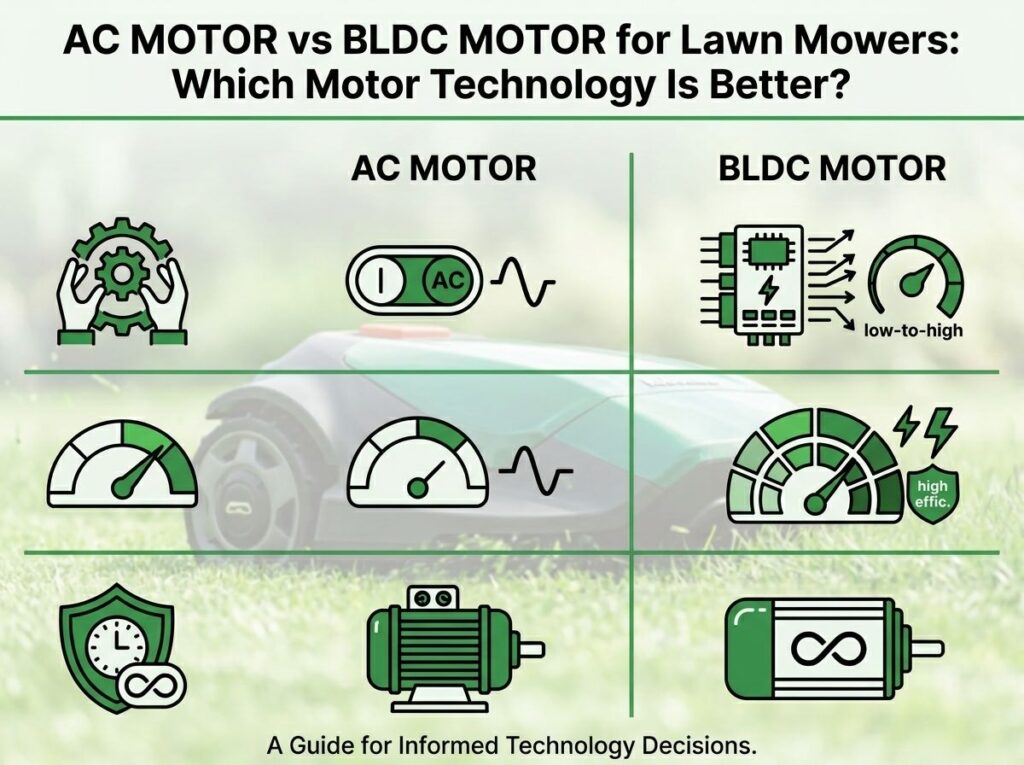
محرك AC مقابل محرك BLDC لجزازات العشب: ما هي تكنولوجيا المحركات الأفضل؟?
When comparing AC motors vs BLDC motors for lawn mowers, the answer depends on the application, performance requirements, and long-term operating cost. Traditional AC motors have powered electric lawn mowers for decades because of their simplicity and low initial cost. لكن, modern cordless and commercial lawn mowers increasingly use Brushless DC (BLDC) motors due to their superior efficiency, كثافة عزم الدوران, controllability, والموثوقية.
For OEM manufacturers, المهندسين, and procurement professionals, motor selection directly affects mower performance, استهلاك الطاقة, متطلبات الصيانة, noise levels, and product competitiveness. While AC motors remain suitable for entry-level corded mowers, BLDC motors have become the preferred solution for premium residential, commercial landscaping, and robotic mowing platforms.
This engineering guide explains the key differences between AC motors and BLDC motors for lawn mower applications, helping manufacturers and buyers make informed decisions based on performance, يكلف, and future market trends.
What Is an AC Motor in a Lawn Mower?
An AC motor converts alternating current electrical energy into mechanical rotation. In lawn mower applications, the most common AC motor types are universal motors and induction motors.
Universal AC Motors
Universal motors are widely used in corded lawn mowers because they are compact, غير مكلفة, and capable of high rotational speeds. Their simple structure makes them attractive for cost-sensitive consumer products.
لكن, universal motors rely on brushes and commutators, creating friction, electrical arcing, and wear over time. These characteristics reduce efficiency and increase maintenance requirements.
المحركات الحثية
Induction motors eliminate brushes and generally offer longer life than universal motors. They are known for durability and simple operation but tend to be heavier and less power-dense than modern BLDC solutions.
Because AC motors are directly powered from utility grids, they are most commonly found in corded lawn mowers where unlimited runtime is a primary advantage.
What Is a BLDC Motor in a Lawn Mower?
محرك DC بدون فرش (BLDC) uses permanent magnets on the rotor and electronically controlled stator windings to generate rotation. Instead of mechanical commutation, electronic controllers manage current flow through advanced switching algorithms.
Modern cordless lawn mowers typically utilize BLDC motors operating from 36V, 48الخامس, 60الخامس, or 72V lithium battery systems.
التبديل الإلكتروني
Electronic commutation eliminates brushes entirely. This reduces friction losses, minimizes maintenance, and significantly improves efficiency.
Intelligent Motor Control
BLDC motors are paired with electronic controllers capable of:
- Variable speed regulation
- Torque optimization
- Current limiting
- Battery protection
- Thermal monitoring
- Load-adaptive cutting performance
This level of control allows mower manufacturers to maximize cutting efficiency while minimizing energy consumption.
Why Are Lawn Mower Manufacturers Switching to BLDC Motors?
The transition from AC motors to BLDC motors is driven by several industry trends, including electrification, battery technology improvements, environmental regulations, and consumer demand for quieter equipment.
Commercial landscaping companies increasingly seek equipment that reduces maintenance costs and improves operational efficiency. BLDC motors address these requirements by delivering higher efficiency and better reliability.
Municipal restrictions on gasoline-powered equipment are accelerating demand for battery-powered lawn mowers. Since battery runtime is heavily influenced by motor efficiency, BLDC technology provides a significant competitive advantage.
بالإضافة إلى, robotic lawn mowers require precise speed and torque control, making BLDC motors virtually mandatory for autonomous systems.
محرك AC مقابل محرك BLDC لجزازات العشب: Complete Performance Comparison
| المعلمة | محرك AC | محرك BLDC |
|---|---|---|
| كفاءة | 60-85% | 85-95% |
| كثافة عزم الدوران | معتدل | عالي |
| Motor Weight | أعلى | أدنى |
| مستوى الضوضاء | أعلى | أدنى |
| صيانة | معتدل | منخفض جدًا |
| Control Capability | أساسي | متقدم |
| Thermal Efficiency | معتدل | ممتاز |
| توافق البطارية | Poor | ممتاز |
| Service Life | معتدل | طويل |
| OEM Integration | محدود | Highly Flexible |
While AC motors continue to offer lower upfront cost, BLDC motors outperform them in nearly every performance metric important to modern lawn mower design.
مقارنة الكفاءة: AC Motor vs BLDC Motor Efficiency
Efficiency determines how much electrical energy is converted into useful mechanical power. In lawn mower applications, efficiency directly affects operating cost, battery runtime, and thermal performance.
AC Motor Efficiency
Universal motors often operate between 60% و 75% efficiency under realistic mowing conditions. Induction motors generally perform better, reaching 80%–85% efficiency depending on size and load.
Losses occur due to:
- Brush friction
- Copper losses
- Core losses
- Mechanical drag
- Magnetic hysteresis
BLDC Motor Efficiency
BLDC motors commonly achieve efficiencies above 90%. Because electronic commutation eliminates brush losses, a larger percentage of electrical energy is converted into useful cutting power.
For battery-powered equipment, higher efficiency translates directly into longer operating time and fewer charging cycles.
من وجهة نظر هندسية, efficiency improvement is one of the strongest arguments for adopting BLDC technology.
Torque Density and Cutting Performance Differences
Torque density refers to the amount of torque produced relative to motor size and weight. Lawn mower performance depends heavily on the ability to maintain blade speed under varying grass conditions.
AC Motor Torque Characteristics
Traditional AC motors often rely on high operating speed rather than optimized torque production. During heavy grass cutting, blade speed can drop noticeably.
This reduction in blade speed negatively affects cutting quality and overall productivity.
BLDC Torque Advantages
BLDC motors provide significantly higher torque density due to permanent magnet rotor construction and advanced current control algorithms.
تشمل الفوائد:
- Improved cutting consistency
- Better wet grass performance
- Higher overload tolerance
- Reduced stalling risk
- Smaller motor packaging
For commercial mowing applications, torque density is often more important than maximum horsepower ratings.
الأداء الحراري وإدارة الحرارة
Thermal management directly affects motor lifespan and reliability. Excessive heat accelerates insulation aging, bearing wear, and electronic component failure.
Heat Generation in AC Motors
Universal motors generate significant heat due to brush friction and electrical arcing. Under prolonged heavy load, winding temperatures can rise rapidly.
Cooling is typically limited to airflow generated by blade rotation or passive ventilation.
BLDC Motor Thermal Advantages
BLDC motors generate less heat because they eliminate mechanical commutation losses.
Additional thermal benefits include:
- Lower copper losses
- Better stator cooling
- Integrated temperature sensing
- Intelligent thermal protection
- Higher sustained power output
For high-power 48V and 72V mower systems, superior thermal performance contributes significantly to reliability and operating life.
الموثوقية وعمر الخدمة: Which Motor Lasts Longer?
Reliability is one of the most important considerations for OEM manufacturers and commercial landscaping operators.
AC Motor Reliability Challenges
Common failure mechanisms include:
- Brush wear
- Commutator erosion
- Electrical arcing damage
- Bearing contamination
- تدهور العزل
Maintenance requirements increase as operating hours accumulate.
BLDC Motor Reliability Benefits
By eliminating brushes, BLDC motors remove one of the primary mechanical wear mechanisms found in traditional AC motors.
Industrial-grade BLDC motors often achieve several thousand operating hours with minimal maintenance.
This makes them particularly attractive for:
- Commercial landscaping fleets
- Municipal maintenance equipment
- Robotic lawn mowers
- Professional outdoor power equipment
AC Motor vs BLDC Motor Cost Comparison
Cost remains one of the main reasons some manufacturers continue using AC motors.
| عامل التكلفة | محرك AC | محرك BLDC |
|---|---|---|
| Initial Motor Cost | أدنى | أعلى |
| تكلفة وحدة التحكم | الحد الأدنى | أعلى |
| تكلفة الصيانة | أعلى | أدنى |
| تكلفة الطاقة | أعلى | أدنى |
| Lifetime Cost | معتدل | أدنى |
Although BLDC systems require a more sophisticated controller and higher initial investment, total ownership cost is frequently lower over the equipment lifecycle.
For OEM manufacturers targeting premium markets, the performance benefits often justify the increased system cost.
How to Choose a Lawn Mower Motor for OEM Projects
Selecting the right motor requires balancing performance, مصداقية, يكلف, and application requirements.
نطاق الجهد
- 24V–36V: Compact residential mowers
- 48الخامس: Mid-range cordless platforms
- 60الخامس – 72 فولت: Commercial equipment
نطاق القوة
- 500W–1000W: Small lawn mowers
- 1.5kW–3kW: Residential premium models
- 3kW–8kW: Commercial applications
Speed and Torque
Engineers should evaluate:
- Blade tip speed requirements
- Peak torque demand
- Overload performance
- Acceleration characteristics
طريقة التبريد
- Passive air cooling
- Forced-air cooling
- Integrated aluminum housing cooling
- Advanced thermal monitoring systems
توافق وحدة التحكم
For BLDC systems, controller integration is critical. OEMs should consider communication protocols, battery management compatibility, and software customization capability.
Greensky Power supports customized BLDC motor solutions for lawn mower manufacturers, including integrated controller matching, custom winding design, and optimized thermal management.
Related solutions:
Request datasheet, get OEM solution, or contact our engineers to discuss your application requirements.
Applications of AC and BLDC Motors Beyond Lawn Mowers
Understanding broader industrial adoption helps explain future technology trends.
التطبيقات الصناعية
BLDC motors increasingly power industrial automation equipment because of their efficiency and precise speed control.
Automotive and EV Applications
Most electric vehicles use brushless motor technologies because efficiency and torque density are critical performance factors.
أنظمة التدفئة والتهوية وتكييف الهواء
Variable-speed HVAC systems increasingly adopt BLDC motors to reduce energy consumption and improve airflow control.
علم الروبوتات
Robotic systems rely heavily on BLDC motors for precision motion control and high power density.
The same engineering principles driving adoption in these industries are accelerating the transition toward BLDC-powered lawn equipment.
Future Trends in Lawn Mower Motor Technology
The future of lawn mower design is increasingly aligned with electrification and intelligent control.
Several major trends are shaping the market:
- 72V commercial battery platforms
- Smart motor controllers
- Predictive maintenance systems
- AI-powered load optimization
- Connected fleet management
- Higher efficiency regulations
As battery costs continue declining and controller technology advances, BLDC motor adoption is expected to accelerate across both residential and commercial markets.
For OEM manufacturers developing next-generation lawn mowers, investing in advanced BLDC platforms today provides a strong foundation for future product competitiveness.
التعليمات: محرك AC مقابل محرك BLDC لجزازات العشب
Which is better for lawn mowers, AC motor or BLDC motor?
For most modern mower applications, BLDC motors offer better efficiency, كثافة عزم الدوران, مصداقية, and controllability. AC motors remain suitable for low-cost corded products but are becoming less competitive in premium and commercial markets.
Why are brushless motors more efficient than AC motors?
Brushless motors eliminate mechanical commutation losses and optimize current flow electronically. This reduces heat generation and improves energy conversion efficiency, especially under varying load conditions.
Do BLDC lawn mower motors last longer?
نعم. BLDC motors eliminate brush wear and reduce mechanical stress. When properly cooled, they often achieve significantly longer service life than traditional AC motor systems.
Are BLDC motors worth the higher cost?
For professional landscaping, commercial equipment, and premium consumer products, the higher efficiency, صيانة أقل, and improved performance often result in a lower total cost of ownership.
What voltage is best for a commercial lawn mower motor?
Many commercial mower manufacturers now prefer 60V to 72V systems because they offer excellent power density, improved thermal performance, and better overall efficiency.
Can BLDC motors be customized for OEM lawn mower projects?
نعم. الجهد االكهربى, تقييم القوة, shaft design, cooling architecture, winding configuration, controller integration, and housing dimensions can all be customized to meet specific OEM requirements.
استنتاج
The comparison between AC motor vs BLDC motor for lawn mowers clearly shows why the industry is moving toward brushless technology. While AC motors continue to offer simplicity and low initial cost, BLDC motors provide superior efficiency, كثافة عزم الدوران, الإدارة الحرارية, مصداقية, and intelligent control capabilities.
For OEM manufacturers, commercial landscaping equipment suppliers, and engineering teams, BLDC motors represent the most future-proof solution for next-generation lawn mower platforms.
Whether developing a 48V residential mower, a 72V commercial mower, or an autonomous robotic mower, selecting the right motor architecture will significantly influence product performance and market success.
Request a datasheet, get an OEM motor solution, or contact Greensky Power engineers to discuss your custom lawn mower motor project.
مراجع
- https://www.energy.gov/eere/vehicles/articles/fact-861-february-23-2015-electric-vehicle-efficiency
- https://ieeexplore.ieee.org/document/9099627
- https://www.sciencedirect.com/topics/engineering/brushless-dc-motor
- https://www.mdpi.com/1996-1073/14/3/655
- https://www.nrel.gov/docs/fy19osti/73396.pdf
- https://www.britannica.com/technology/electric-motor
- https://www.energy.gov/energysaver/lawn-and-garden-equipment
- https://www.iea.org/reports/energy-efficiency-2024